Uncertainty Quantification (UQ) seeks to characterize, propagate, and reduce the uncertainties affecting data, models, numerical simulations, and the decisions informed by their results.
It provides tools to assess the reliability of predictions, identify the most influential parameters, construct confidence intervals or confidence sets, and guide the acquisition of new simulations or observations. At L2S, these topics are explored through four complementary research themes:
As part of its uncertainty quantification activities, L2S actively contributes to:
Surrogate models, or metamodels, emulate computationally expensive numerical models to provide faster evaluations. They enable more efficient exploration of parameter spaces, uncertainty propagation, and sensitivity, optimization, and reliability analyses.
Research in this area focuses on Gaussian processes (kriging) and polynomial regression, including polynomial chaos, for deterministic or stochastic numerical models. The objective is to build fast, reliable approximations suited to scientific and industrial applications.
References:
[PBV25]
Relaxed Gaussian process interpolation: a goal-oriented approach to Bayesian optimization (JMLR)
[ZS25]
Polynomial chaos expansions of simulators with mixed continuous and categorical variables (UNCECOMP)
[BGRS24]
Rational kernel-based interpolation for complex-valued frequency response functions (SISC)
[PBFV23]
Parameter selection in Gaussian process interpolation: An empirical study of selection criteria (JUQ)
[RBD17]
Assessing fire safety using complex numerical models with a Bayesian multi-fidelity approach (Fire Saf. J.)
Software: STK (Matlab/Octave), GPmp (Python)

Uncertainty quantification associates model predictions with information about their reliability. It is central to trustworthy AI, particularly when safety, robustness, and risk control are essential.
This research addresses calibration, prediction intervals, and statistical guarantees. Conformal prediction provides a general framework for producing prediction sets or intervals with coverage guarantees under weak assumptions.
References:
[PV26]
Goal-Oriented Lower-Tail Calibration of Gaussian Processes for Bayesian Optimization (ICML)
[BZ26]
Uncertainty functionals revisited: Concavity and Jensen’s inequality (mODa)
[HZS26]
Conformal prediction for full and sparse polynomial chaos expansions (preprint)
[PV25]
Design-marginal calibration of Gaussian process predictive distributions: Bayesian and conformal approaches (preprint)
[PV24]
Gaussian process interpolation with conformal prediction: methods and comparative analysis (LOD)

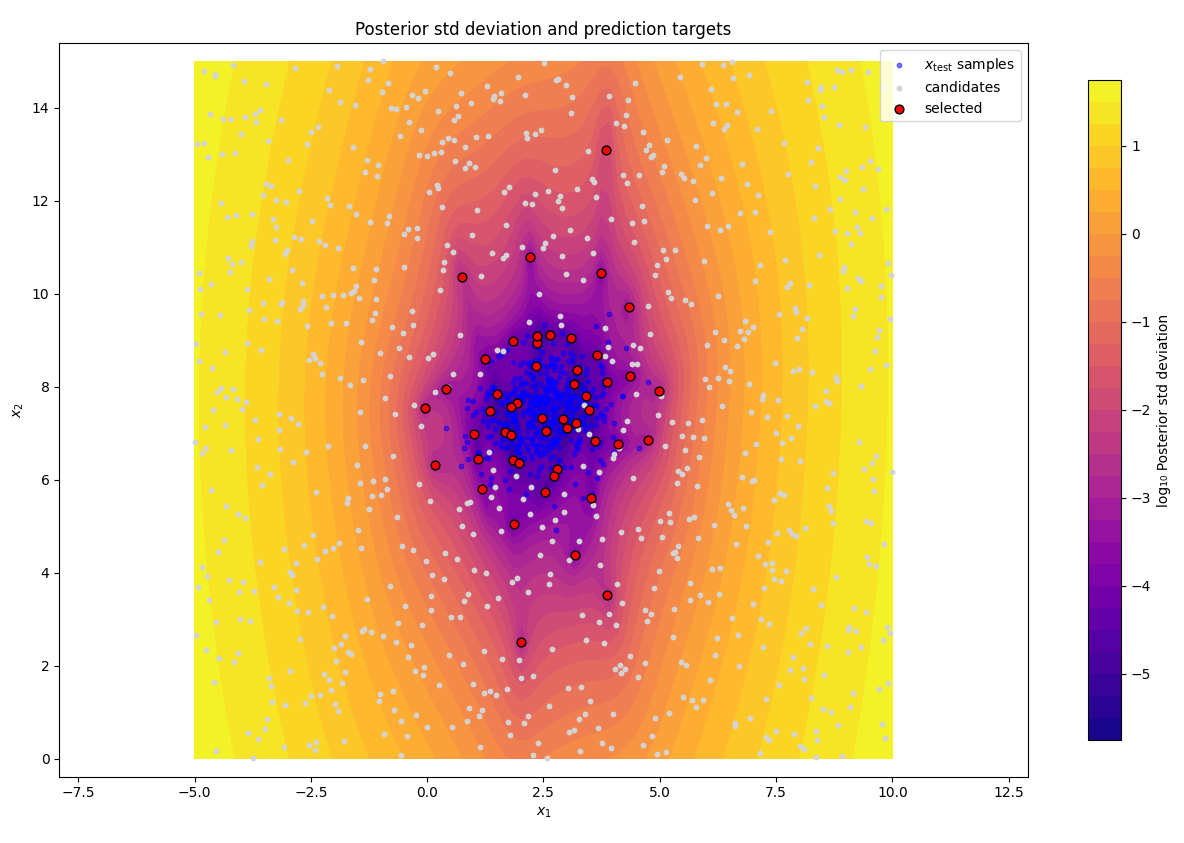
Active learning sequentially selects the most informative simulations, experiments, or observations. It focuses computational or measurement resources on regions where uncertainty is greatest or where the expected information is most useful.
Research covers the design of numerical experiments, Bayesian optimization, rare-event probability estimation, and stochastic or multi-fidelity simulators. These methods make the exploration of complex models more efficient.
References:
[ABC25]
Bayesian sequential design of computer experiments for quantile set inversion (Technometrics)
[ABV25]
Bayesian Active Learning of (small) Quantile Sets through Expected Estimator Modification (preprint)
[SBD22]
Sequential design of multi-fidelity computer experiments: Maximizing the rate of stepwise uncertainty reduction (Technometrics)
[AGC21]
Adaptive Design of Experiments for Conservative Estimation of Excursion Sets (Technometrics)
[BBG19]
A supermartingale approach to Gaussian process based sequential design of experiments (Bernoulli)
Industrial system monitoring uses signal processing, statistics, and information theory to detect, diagnose, and anticipate abnormal behavior in complex systems.
This research addresses anomaly detection, state estimation, fault diagnosis, and decision support. Applications include mechanical, energy, and electromagnetic systems, as well as instrumented infrastructure.
References:
[ZDD26]
Cross-dataset battery life forecasting with time-series foundation models: From zero-shot to prefix-adapted (Energy and AI)
[HPD26]
State of Health Evaluation of Lithium-Ion Batteries Using the Statistical Properties of the Voltage (Entropy)
[ZWD24]
Incipient near surface cracks characterization and crack size estimation based on Jensen–Shannon divergence and Wasserstein distance (Journal of Nondestructive Evaluation)
[YD22]
An incipient fault diagnosis methodology using local Mahalanobis distance: Detection process based on empirical probability density estimation (Signal Processing)
[LDD21]
Application of Artificial Neural Networks to photovoltaic fault detection and diagnosis: A review (Renew. Sustain. Energy Rev.)


Associate Professor – CentraleSupélec
Signaux et statistiques – Signal & Stat
julien.bect@l2s.centralesupelec.fr
Bât. Breguet .